
Hilbert(t) = x+iy continuously maps the unit interval [0,1] onto the unit square [0,i+1]. If one (respectively both) of x and y are dyadic rationals, there are two (respectively three) inverse images t. Hilbert can be implemented by a finite state machine which eats two bits of t and emits one bit each of , and y. Thus if t is rational, then so are x and y. I believe I once showed that the Thue constant T = . 0110100110010110... and 1-T are the only solutions to Hilbert( t)=t+i.
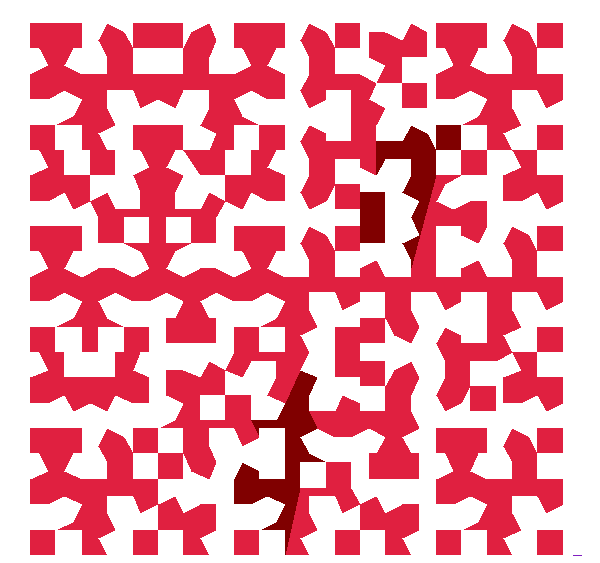
The following are filled, connect-the-dots polygons generated by successive values of Hilbert given t in various arithmetic progressions.




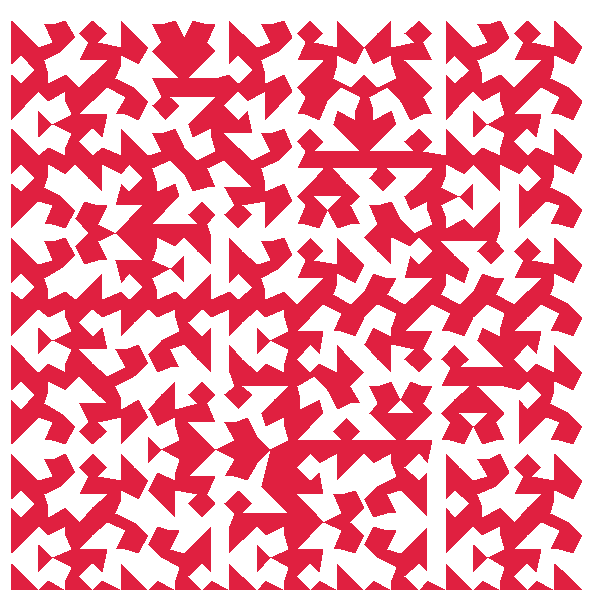

The previous was actually an erroneous rendition of










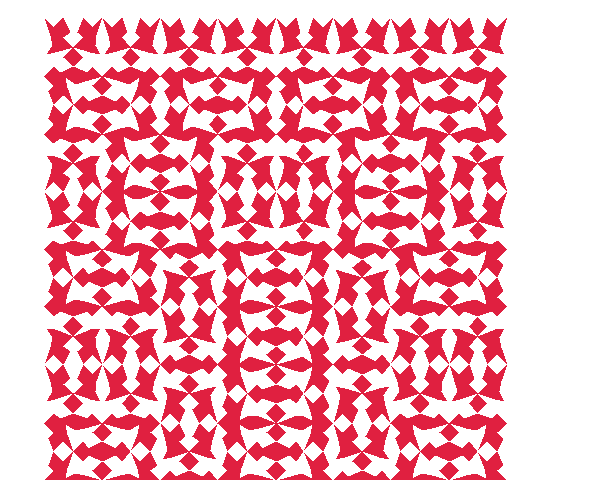





Hilbert((14n+9)/256). Thus the white triangle is not equilateral. (Why not?)
